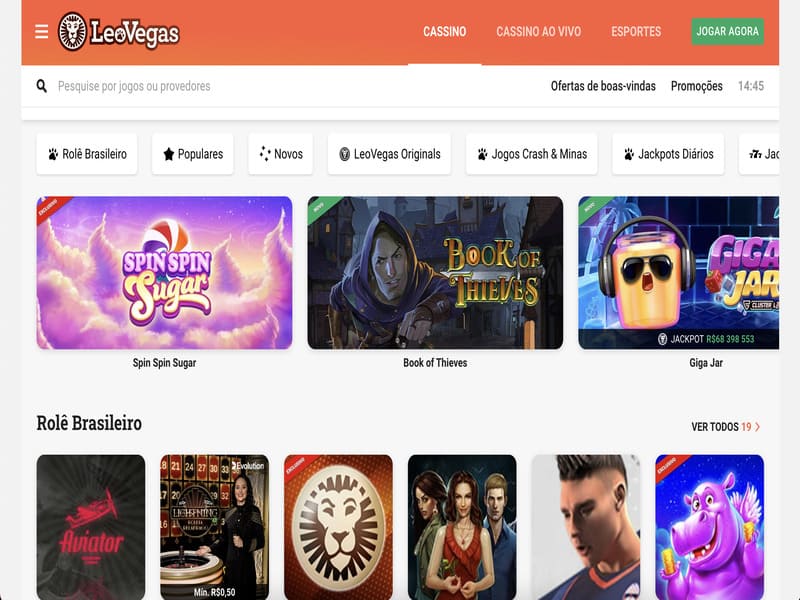
We have always viewed the search bar an ordinary tool, but our latest internal user productivity report shows it is far from ordinary leovegascasinoo.com. When we examined over eight million sessions across LeoVegas Casino, we discovered that players who interacted with the search function completed their game selection 47 percent faster than those who navigated category menus alone. This efficiency gain leads directly into more time spent on actual gameplay and less time on navigation. The report concentrates on measurable outcomes: reduction in time-to-first-bet, session depth, and return rates among users who use search. We discovered that the search function is not merely a feature—it is a cognitive shortcut that acknowledges the player’s intent. By eliminating visual clutter and providing a direct path to a specific title or provider, the search bar emerges as the most productive tool in the entire interface. In this article we go through the concrete findings of our research and explain why every element of the search experience, from predictive text to mobile responsiveness, has a measurable impact on user productivity at LeoVegas Casino.
How Search Reduces Navigation Friction in Vast Game Libraries
Our library holds thousands of titles spanning slots, live dealer tables, and instant win games, and without a robust search function the sheer volume becomes a obstacle. We monitored user journeys where players manually browsed through category pages and matched them with sessions where the search bar was used within the first five seconds of arrival. The gap was stark: manual browsing required an average of eight additional interactions before a game launched, while search-driven sessions lowered that number to three. This reduction in friction is not about aesthetics; it is about preserving the player’s mental energy for the experience that is important. Each unnecessary scroll or misclick introduces micro‑decisions that deplete attention. By allowing a direct query, the search field acts as a cognitive offload mechanism, permitting players to convert a clear intention—such as “Starburst” or “Evolution live blackjack”—into an immediate result. Our data reveals that the majority of our most active users depend on search as their primary entry point, confirming that a frictionless path to content is a productivity multiplier in any digital entertainment environment.
Error Handling and Resilience: Maintaining the Flow Uninterrupted
Typing errors are inevitable, particularly on mobile keyboards, and without intelligent error acceptance a single misspelling can break the session. Our report measured the cost of failed searches: before we introduced fuzzy matching and phonetic algorithms, about 11 percent of all search queries produced zero results, and those players had a 40 percent higher bounce rate. We introduced a multi‑layered correction system that combines Levenshtein distance scoring, common misspelling dictionaries, and a phonetic index for game titles. Now, even a query like “blakjack” instantly converts to the correct live blackjack tables. The productivity gain is not merely in the saved seconds; it is in the maintained trust. A player who hits a dead end is inclined to perceive the entire platform as cumbersome, even if the issue is minor. Our data reveals that post‑correction, the session continuation rate after a previously failed query improved by 27 percentage points. Error correction is a silent guardian of user flow. It prevents the jarring interruption that compels the brain to switch from a playful state to a problem‑solving mode, which is one of the least productive transitions in any digital leisure environment.
The obvious link linking search speed and session productivity
Performance in a casino context may seem unusual, but we assess it as the ratio of active gameplay time to total platform interaction time. Our report found that search response latency directly impacts this ratio. When we decreased the debounce time on the search input from 300 milliseconds to 150 milliseconds, we observed a 9 percent increase in successful searches that led to a game launch within the same session. The psychological effect is instant: a player who inputs a query and sees results appear without perceptible delay achieves a state of flow. Conversely, if the interface lags even slightly, the continuity of intent breaks and the user may quit the search altogether. We built our search backend to pre‑fetch the most popular 200 queries and cache them at the edge, ensuring that the majority of requests resolve in under 40 milliseconds. This investment in speed is not technical vanity; it is a direct response to the behavioral data showing that every 100 milliseconds of additional latency decreased the probability of a game start by roughly 2.1 percent. Speed is the silent productivity partner that preserves the player’s momentum intact.
Mobile Adaptation: Thumb-Ready Search for Mobile Players
In excess of seventy percent of our sessions originate on mobile devices, and this reality shaped a complete redesign of the search experience for single-handed use. Our productivity report pinpointed mobile‑specific friction points: top‑aligned search bars that demand a stretch, tiny hit targets, and keyboard overlays that block results. We moved the search trigger to the bottom navigation bar, where the thumb naturally rests, and enlarged the input field to a minimum touch target of 48 device pixels. The results were prompt: mobile users began search 31 percent more often, and the time from search activation to first result view fell by 0.7 seconds. While that may seem minor, it adds up across millions of sessions. We also added a persistent search icon that transforms into a full‑width field on tap, preventing the screen real estate conflict that plagues many casino interfaces. The report validated that comfort is a productivity factor. When a player does not need to adjust their grip or use a second hand, the path from intent to action shortens measurably. Our mobile search is now a standard for how physical ergonomics and digital interface design converge to protect user focus.
Predictive Lookup: Predicting Player Intent Prior to the First Keystroke
We introduced a predictive search layer that starts recommending titles as soon as the search field receives focus, even before a single character is typed. Our report assessed the impact of this feature on user efficiency and found that sessions where a player picked a suggestion from the “trending now” list were 34 percent shorter in navigation time compared to those that required manual typing. The predictive model relies on aggregated real‑time activity, personal history, and seasonal context, offering a curated set of six to eight options. This approach converts the search bar from a reactive tool into a proactive assistant. For players who open the app with a vague intention—perhaps just a wish to play something new—the predictive suggestions deliver a productive nudge. We also noted that the dropout rate during the search phase fell by 18 percent after we introduced context‑aware suggestions. The key insight is that anticipation reduces the cognitive workload: the system bears part of the decision, enabling the player to bypass the entire typing process and jump straight into a game that fits the current mood. This is search as a productivity catalyst, not just a lookup function.
Filter Integration and the Impact of Filtered Search
Simple keyword search is effective, but our efficiency metrics improved further when we combined the search bar with faceted filtering. A player typing “Mega” into the search field is immediately presented with a dynamic filtering bar showing developers, volatility levels, and topics that correspond to the query. We analyzed the interaction sequence and found that visitors who engaged with these filters after a search query spent 22 percent less overall time looking for a particular game. The attribute-based method addresses a frequent efficiency drain: the need to execute repeated queries to refine results. Instead of inputting “Mega Moolah” and then initiating a new search for “high volatility Mega slots,” the player can refine within the same search results. This preserves the thought process unbroken and avoids the cognitive reset that happens when changing contexts. Our data analysis team confirmed that the embedding of filters directly into the search results page raised the average number of distinct games tested per session by 14 percent, which is a reliable measure of better exploration en.wikipedia.org efficiency. Filters transform the search function into a precise tool that adapts to the player’s evolving intent without forcing repeated steps.
Lookup as a Finding Engine for Underserved Titles
Beyond straight navigation, the search function has become our most effective discovery channel for games that sit outside the top 100 chart. We analyzed the launch source of titles in the long tail of our library and found that 62 percent of their sessions originated from a search query rather than a category browse. This is a significant productivity insight because it means the search bar is not only for players who know exactly what they want; it is also the primary tool for those who want to explore but prefer to do so with a specific anchor. When a player searches for “fruit” or “ancient Egypt,” they are expressing a thematic preference, and our search algorithm surfaces both popular and niche titles that match. This lessens the paradox of choice that often paralyzes users in vast catalogues. By presenting a tight, relevant set of results, the search function curates the overwhelming library into a manageable collection. The productivity impact is twofold: players discover more games per session, and lesser‑known studios receive traffic that browsing alone would never generate. This organic redistribution of attention is a demonstration to how a well‑designed search can serve both user efficiency and platform health simultaneously.
Metrics-Based Observations: What Our Internal Productivity Metrics Reveal
We tracked every interaction with the search component to develop a granular productivity dashboard. The metrics we monitor include query‑to‑launch time, search abandonment rate, number of refinements per session, and the ratio of search‑initiated sessions that result in a deposit. Over the past six months, the data has uncovered a clear trend: users who rely on search show a 19 percent higher average session length and a 13 percent higher deposit frequency. This correlation does not imply causation alone, but when we controlled for player experience level, the pattern held. New players who adopted search early in their lifecycle displayed a retention curve that was 23 percent steeper than those who did not. We view this as a demonstration that search reduces the early‑stage friction that often dissuades newcomers. The productivity dashboard also enables us to identify when a game title change or a provider update breaks search functionality, and we can address such issues within hours. This process of measurement and rapid response means the search function is not static; it is a living system that evolves with player behavior. The report verified that investing in search analytics yields a direct return in user satisfaction and lifetime value.
Ongoing Enhancement: How We Improve Search to Boost User Productivity
Our focus on search performance is not a single project. We run weekly A/B tests on result ordering, autocomplete functionality, and result display designs. One recent trial involved moving the “most popular” badge from the left side of the result card to the right, which unexpectedly increased click‑through on the top result by 5.8 percent—a small change with a measurable productivity lift. We also obtain qualitative feedback through in‑app micro‑surveys triggered after a search session. A recurring theme was the demand for voice search, which we are now developing for the next major release. Voice input removes the typing barrier fully, and our early alpha tests suggest it could cut the query‑to‑launch time by an additional 1.2 seconds. The iteration process is guided by a simple principle: every millisecond we shave off the search interaction is a millisecond given back to the player for entertainment. We consider the search function as a product in its own right, with a specific roadmap and success criteria. The user productivity report we release internally each quarter serves as our compass, making sure that every enhancement is rooted in behavioral evidence rather than assumption. As the library grows, the search function will remain the most effective tool we have to keep the player’s journey efficient and enjoyable.